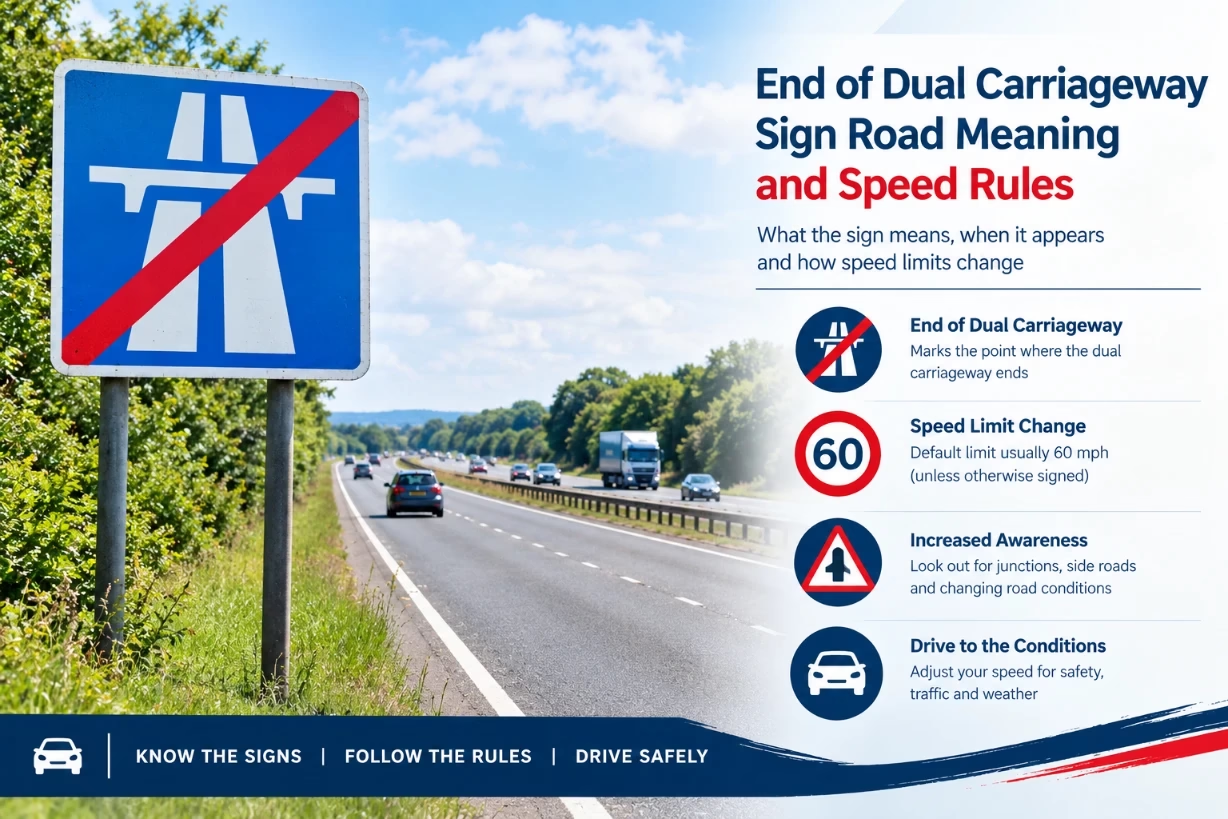
The end of dual carriageway sign tells you the separated lanes are about to finish, turning the road back into a single carriageway, and that usually means lower speed limits, more hazards from oncoming traffic, and the need to adjust your speed and lane position quickly but smoothly.
When I first started driving, the end of dual carriageway sign felt like a small detail that did not matter much. Over time, I realized that this one sign quietly changes almost everything about how you should drive for the next stretch of road. Speed rules shift, the type of traffic around you changes, and the margin for error gets much smaller. In this guide, I will walk you through what the end of dual carriageway sign really means, how it affects speed limits, what to do when you see it, and how to stay safe in real situations.
What the end of dual carriageway sign actually means
The end of dual carriageway sign appears where a divided highway with a central barrier or gap ends, and the road becomes a single carriageway again. On a dual carriageway, the two directions of traffic are physically separated. After the sign, both directions usually share the same road space with only painted lines between them.
So when you see the end of dual carriageway sign, it usually means three things at once:
First, the physical barrier or median that separated you from oncoming traffic is about to disappear. Second, the road layout is about to narrow or merge, often with fewer lanes. Third, the legal or safe speed may need to change fast, even if the posted number is still catching up a few hundred yards ahead.
That is why the end of dual carriageway sign matters for speed rules. It silently warns you that what was safe or legal thirty seconds ago may not be safe or legal in thirty seconds from now.
How the end of dual carriageway sign affects speed limits
One of the most confusing parts of this topic is that the end of dual carriageway sign does not always come with a new speed limit sign right next to it. That leaves people asking, “Do I keep the same speed or slow down?” The honest answer is that you need to think about both the legal side and the safety side.
Legal speed rules after the end of dual carriageway
The legal speed after you pass an end of dual carriageway sign depends on three main details: the posted limit signs, the type of road you are entering, and the type of vehicle you are driving.
If there is a new speed limit sign placed near the end of dual carriageway sign, that number is your rule. But even if the posted number does not change right away, some countries and states use different default limits for single carriageways and dual carriageways. That means the road category alone can change what is allowed once you pass the sign.
Larger vehicles like trucks, buses, vans, and vehicles towing trailers often have lower limits than regular cars on single carriageways. So after the end of dual carriageway sign, some drivers must reduce speed by law, even if car drivers do not.
Because rules differ by region, I always suggest you check your local highway code or driver handbook. Search specifically for the words “single carriageway speed limit,” “dual carriageway speed limit,” and “end of dual carriageway sign” for your state or country. It is dry reading, but it can keep you from getting tickets or worse.
Safety speeds vs legal speeds
There is also a big difference between the legal speed and the safe speed after the end of dual carriageway sign. Legally, you might still be allowed to keep the old limit for a short distance. But the safe speed often needs to drop sooner because of how single carriageways behave.
On a single carriageway, you sit much closer to oncoming vehicles. Head-on collisions often happen at a much higher combined impact speed than side swipes on a dual carriageway. You may face hidden driveways, farm entrances, cyclists on the edge of the road, or pedestrians on the shoulder. That alone is reason to back off the gas when you see the sign.
I like to think of the end of dual carriageway sign as a kind of “pre-brake” warning. Even before you see a lower speed limit sign, you start preparing your speed and scanning behavior as if you are already on a more dangerous road, because effectively, you are.
How to drive when you see the end of dual carriageway sign
When that sign comes into view, you do not have a lot of time. But you can still follow a clear pattern in your head: look, think, adjust, and then settle.
Step 1: Look ahead and behind
The instant you notice the end of dual carriageway sign, first check your mirrors. See who is behind you and how close they are. Then look far ahead. You want an early sense of how the road changes: does it curve, narrow, or climb uphill right after the sign? Are there junctions, side roads, or farm tracks?
This early scan helps you avoid last second braking, which can surprise the driver behind you who might still be locked into dual carriageway thinking and dual carriageway speed.
Step 2: Think about space, not just speed
On a dual carriageway, you often have wider lanes and sometimes a shoulder or hard strip. After the end of dual carriageway sign, your safe space can vanish fast. That is why I like to focus more on space than on the exact number on the speedometer at first.
Ask yourself simple questions: Can I still stop in the distance I can see is clear? Do I have a escape path if the oncoming car drifts toward the center line? If the answer feels shaky, then your speed is too high for the new road, no matter what the last sign said.
Step 3: Adjust speed smoothly
Now you gently ease off the accelerator, rather than slamming the brakes. As you pass the end of dual carriageway sign, you should already be in the process of slowing a bit, tightening up your reaction time, and preparing to match whatever new limit appears ahead.
Sudden hard braking right at the sign is dangerous. It confuses drivers behind you who might not have seen the sign yet. Smooth, early adjustment sends a much clearer message to anyone following your car.
Step 4: Settle into a new rhythm
Once you are clearly on the single carriageway, do a quick mental reset. You are no longer on a divided highway. Expect slower vehicles. Expect people pulling out of side roads. Expect tractors, cyclists, and maybe kids coming out of driveways in rural areas.
After a few minutes, you want to settle into a steady, legal, and comfortable speed instead of constantly speeding up and slowing down. That steady rhythm makes you less tired and more focused.
Common hazards after the end of dual carriageway sign
Over the years, I have seen the same set of dangers show up again and again right after an end of dual carriageway sign. Knowing them ahead of time makes it easier to stay out of trouble.
Sudden lane drops and merges
Often, what used to be two or three lanes in your direction narrows down to one. If you are in the outside lane when you see the end of dual carriageway sign, you should expect a merge arrow or “lane ends” sign soon afterward.
Do not wait until the last second to push your way in. Check your blind spot, signal early, and merge with enough space. Drivers on your inside lane may be focused on the sign or the new shape of the road, so they might not see a late, sharp lane change from you.
Oncoming traffic much closer than before
On a divided road, you can sometimes forget that the other direction is even there. After the end of dual carriageway sign, oncoming cars come right back into your visual and emotional space. Headlights, glare, and closing speeds become important again, especially at night or in rain.
Keep a little extra space between your car and the center line. If the road is narrow or badly marked, pulling slightly to the right or left (depending on your country’s driving side) within your own lane can give you a little buffer against wandering drivers.
Hidden driveways and side roads
Once the road becomes a single carriageway, it often passes close to homes, farms, small businesses, and side streets. That means more places where vehicles may suddenly join the road or turn off it.
If you see buildings, mailboxes, or driveways near the edge, that is your clue to keep your speed on the lower end of the limit. The end of dual carriageway sign is sometimes the last clear warning before all this activity starts.
Weather and lighting changes
Dual carriageways are often built and maintained to a high standard, with smooth surfaces and good drainage. Single carriageways can be rougher, narrower, and less even. When rain, fog, or darkness adds to that, the road can change character very quickly after the end of dual carriageway sign.
If you are moving from a bright, open highway section into a tree-lined or built-up single carriageway, give your eyes time to adjust. Slow down a little until your vision and the new environment feel comfortable.
Why the end of dual carriageway sign matters so much for young drivers
If you are a new driver, the end of dual carriageway sign can feel like just another item in the driver handbook. But it actually teaches a key lesson: the type of road matters just as much as the number on the sign.
On a dual carriageway, you learn to keep lane discipline, manage higher speeds, and handle merges at ramps. When you pass the end of dual carriageway sign, you enter a different driving world that asks for more careful judgment, more patience, and more reading of the environment, not just the signs.
Some younger drivers get in trouble because they carry their dual carriageway speed and mindset into a single carriageway, thinking, “If it was safe a minute ago, it must still be fine.” That is how people end up overtaking when there is not enough space or driving too fast into blind bends after the sign.
As someone who has watched that mistake play out, I can say this: the end of dual carriageway sign is not just a technical sign. It is a mental reset trigger. When you respect it, you give yourself time to stay safe.
How different regions treat the end of dual carriageway sign
Laws and exact sign shapes differ around the world, but the core meaning of the end of dual carriageway sign stays mostly the same: your divided highway protection is ending. Still, a few patterns show up that can help you wherever you drive.
Placement and distance before the change
In some countries, you see an advance sign warning that the dual carriageway will end in a certain distance. In others, the main end of dual carriageway sign stands right at the exact point where the barrier stops.
When you drive in a new country or state, take a few minutes online or in the local handbook to check if they use advance warnings or not. That small detail changes how early you should start slowing down.
Link with town or village entries
Quite often, the end of dual carriageway sign appears shortly before entering a village, small town, or suburban area. That means you may meet both a change in road structure and a sharp drop in speed, for example from a higher rural limit to a lower built-up limit.
When you see the sign, scan ahead for houses, shops, and streetlights. If you see them, assume a lower speed is coming next, even if you cannot see the sign yet.
Enforcement zones and cameras
Because drivers often stay in “fast road” mode after the end of dual carriageway sign, many enforcement agencies place speed cameras or patrols not far beyond that point. They know drivers are likely to drift above the new limit, especially on mild downhill slopes where the car “quietly” picks up speed.
If you respect the end of dual carriageway sign and adjust early, you are less likely to end up with a ticket or worse, an accident report.
Practical tips to remember the sign and speed rules
When you are out on the road, you do not have time to recall long rules. You need short habits. Here is a simple way I remember how to treat the end of dual carriageway sign in real life.
“Barrier gone, buffer gone” rule
I use a small phrase in my head: “Barrier gone, buffer gone.” When I see the end of dual carriageway sign, I tell myself that my safety buffer has just shrunk, even if my lane still looks wide for a moment. That phrase reminds me to back off my speed and widen my mental alertness.
Match your speed to what you can see
Instead of staring at the speedometer alone, I match my speed to the distance I can clearly see. On a single carriageway after the end of dual carriageway sign, if I cannot see very far because of bends, hills, or trees, I lower my speed until I feel I could stop within what I can see.
Use signs in pairs
I like to think of the end of dual carriageway sign as part of a pair. The first sign tells me the type of road is ending. The next sign tells me the new official speed. I mentally connect them. The moment I see the first, I start predicting what the second will say, so I am ready for it.
Mistakes to avoid after the end of dual carriageway sign
A few mistakes come up so often that they are worth calling out clearly. If you can avoid these, you are already way ahead of many drivers.
Keeping cruise control on at the old speed
If your car has cruise control and you keep it at the higher dual carriageway speed after the end of dual carriageway sign, you force yourself to react late to new limits and surprises. It is far better to turn cruise control off when you see the sign, adjust by foot, and only turn it back on once you know the new limit and feel settled.
Overtaking too close to the change
Trying to overtake another vehicle just before or right after the end of dual carriageway sign is very risky. Road space may narrow, sight lines may shorten, and oncoming traffic may appear faster than you expected once the barrier is gone.
Unless you have a long, clear view and know the limit ahead, hold off on overtaking until you are fully into the new single carriageway and have had time to read the road layout.
Ignoring your gut feeling
Sometimes, when you pass the end of dual carriageway sign, something just feels wrong: maybe the road looks slippery, maybe it feels too dark, or maybe the traffic seems chaotic. Do not ignore that feeling. It is your brain picking up clues faster than your conscious thoughts.
In those moments, dropping your speed a little below the limit and increasing your distance from the car in front can turn a near miss into a non-event.
Bringing it all together
The end of dual carriageway sign may look simple, but it marks a turning point in how you should drive. It tells you that the shield of a central barrier is gone, the risk of head-on conflict is back, and the world beside the road is about to get closer and more complex. When you treat that sign with respect, you give yourself the space and time to handle the new speed rules and new hazards calmly.
Whenever you see the end of dual carriageway sign, think of it as a friendly nudge on the shoulder. It is your chance to reset your speed, your awareness, and your expectations before the road does it for you in a harsher way.