
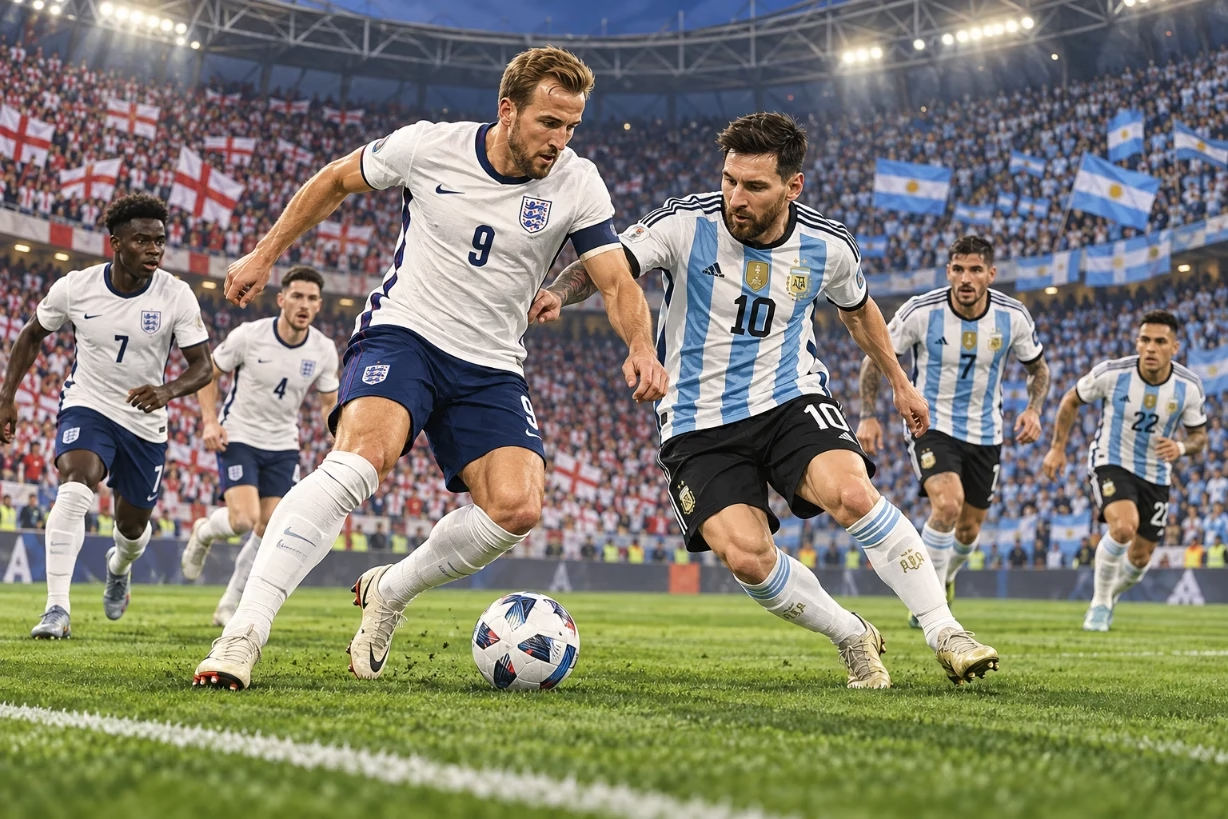
England national football team vs Argentina national football team matches have produced drama, controversy, genius, and heartbreak, turning what starts as a football game into something that feels much bigger for both nations.
Why England vs Argentina Feels Bigger Than A Normal Game
When I talk about england national football team vs argentina national football team matches, I am not just listing scores. These games carry history, politics, pride, and raw emotion. Fans on both sides grow up hearing stories about Maradona, Beckham, disallowed goals, red cards, and penalty shootouts. By the time the teams walk out, the weight of the past is almost a player on its own.
This matchup has everything a true football rivalry needs. There are World Cup classics across decades, stars at the peak of their careers, and moments that still spark arguments in pubs and living rooms. For many, England vs Argentina is the purest example of how football can mix sport with memory and identity.
Early Chapters: The First World Cup Meetings
The story of england national football team vs argentina national football team matches on the global stage really took shape at the World Cup. The first World Cup clash came in 1962 in Chile. That game finished 1–0 to England, a tight match that hinted at the stubborn, physical style that would define many of their future meetings.
But the rivalry truly caught fire in 1966, when Argentina traveled to England for the World Cup that the hosts eventually won. The quarterfinal at Wembley ended 1–0 to England, but the real legacy was the chaos. Argentina captain Antonio Rattin was sent off in a storm of confusion and anger. English fans saw Argentina as dirty and cynical. Argentine fans saw England as protected by officials and home advantage. From that night, every future game between these two teams carried a grudge.
1986: Hand of God And Goal of the Century
If you mention england national football team vs argentina national football team matches, people almost always jump straight to Mexico 1986. That World Cup quarterfinal might be the most famous single game in the rivalry, and maybe in World Cup history.
The match came only a few years after the Falklands War between the United Kingdom and Argentina, which added a heavy emotional layer. For many fans, it felt like more than sport, even if the players tried to treat it as just a game.
Two moments from that game are burned into football memory. First came Diego Maradona’s “Hand of God” goal, when he used his hand to beat goalkeeper Peter Shilton to the ball and scored. The referee missed the handball, the goal stood, and English fans felt robbed. Soon after, Maradona picked up the ball in his own half, glided past one defender after another, and scored what FIFA later called the “Goal of the Century.” It was pure art, the kind of goal that makes even angry rivals stop and admire.
Argentina won 2–1 and went on to win the World Cup. For England, 1986 created a lifelong wound. For Argentina, it became a proud national memory. From that point on, every England vs Argentina game was shaped by those few minutes of Maradona magic and mischief.
1998: Beckham’s Red Card And Penalty Heartbreak
The next big chapter in england national football team vs argentina national football team matches arrived in 1998 at the World Cup in France. If 1986 belonged to Maradona, 1998 turned into the story of David Beckham.
In the round of 16, England and Argentina produced another wild game. There were two penalties in the first half, one for each side. Teenager Michael Owen scored a stunning solo goal that still makes highlight reels, sprinting past defenders and finishing calmly. By halftime it was 2–2, and the match already felt legendary.
Then came the turning point. Early in the second half, Beckham flicked a small kick at Diego Simeone after a foul. The contact was soft, but Simeone made sure the referee noticed. Beckham saw red, England were down to ten men, and from that moment the narrative of the game changed. England fought bravely, but after extra time the score stayed 2–2, and Argentina won on penalties.
Back home in England, Beckham faced an incredible backlash. Newspapers blamed him for the exit. Fans booed him for months. Over time, his story became one of redemption, but that night in Saint-Étienne locked another painful memory into the history of this rivalry.
2002: Beckham’s Revenge In Japan
Four years later, fate brought them together again at the 2002 World Cup in Japan and South Korea. This time, it was a group stage match, but for English fans it felt like a personal mission. It was Beckham against Argentina, part two.
The game itself was tight and tense. England defended with discipline, while Argentina tried to find holes between the lines. Right before halftime, Michael Owen won a penalty. Beckham stepped up, with the weight of 1998 still hanging over every step he took. He drilled the ball low into the corner and roared with relief and fury. England held on for a 1–0 win.
That victory was more than just three points. For Beckham, it was a powerful personal closure. For England supporters, it felt like a small payback for the pain of 1986 and 1998. For Argentina, it was a bitter defeat that contributed to an early World Cup exit. When people talk about england national football team vs argentina national football team matches, 2002 is often remembered as the night the villain from 1998 became a hero.
The Full World Cup Record Between England And Argentina
Looking at england national football team vs argentina national football team matches at the World Cup gives a clear sense of how balanced and tense this rivalry is. These two nations have faced each other several times on the biggest stage, across group phases and knockout rounds.
Across all World Cup meetings up to 2002, England slightly edged the record in terms of wins, but Argentina had the most iconic single victory in 1986 and the emotional penalty success in 1998. Every matchup felt like a new chapter rather than a simple replay of past games. Even when the scoreline was low, the emotional stakes were sky-high.
That balance is part of why search interest in england national football team vs argentina national football team matches stays strong. Fans do not come for one-sided history. They come for knife-edge games, late drama, and long debates over refereeing decisions and tactical choices.
Friendly Matches And Less-Talked-About Meetings
While World Cup games draw most of the spotlight, England and Argentina have also met in friendlies and other internationals. These matches are often used to test new players or systems, but they never feel fully relaxed. The badge on the other shirt is too familiar and too loaded with history.
In some friendlies, England have produced sharp attacking displays. In others, Argentina have shown the kind of technical control and quick, short passing that they are famous for. Because the rivalry is so thick, even a friendly can produce flashpoints: heavy tackles, arguments, and crowd noise that sounds more like a tournament game.
These lesser-known games still add depth to the story of england national football team vs argentina national football team matches. They keep the rivalry alive in years when there is no World Cup clash, and they hand new generations of players their first taste of this unique pressure.
Styles, Identity, And Culture On The Pitch
One reason this matchup fascinates me is how clearly you can see the football culture of each country reflected in their play. England often bring power, speed on the wings, and a focus on crosses, set pieces, and direct attacks. Argentina usually lean on technique, close control, and creative movement in tight spaces.
Of course, both sides have changed over time. Modern England are much more comfortable playing out from the back and controlling possession. Modern Argentina can be extremely well-organized and disciplined in defense, not just expressive in attack. Still, when they meet, the old stereotypes linger in the air: English grit versus Argentine flair.
You feel these contrasts in specific moments: an Argentine midfielder slipping through a clever through ball, an English center back winning a huge header, an intense tackle that sparks a crowd reaction. These details are exactly what give england national football team vs argentina national football team matches their flavor. It is not just the score that matters, but the clash of styles and identities.
Key Players Who Shaped The Rivalry
Over the years, several names have become almost tied to this fixture. Diego Maradona above all, of course, for what he did in 1986. His dual role as trickster and genius in that game made him a symbol of both the beauty and the controversy of the rivalry.
Then there is David Beckham, whose career arc against Argentina runs from villain in 1998 to hero in 2002. His red card against Simeone and later penalty winner show how a player can carry national emotions on his shoulders in england national football team vs argentina national football team matches. For a long time, you could not talk about this fixture without talking about him.
On the Argentine side, figures like Mario Kempes, Gabriel Batistuta, and later Lionel Messi belong to different eras, but they all helped shape the national style and confidence that Argentina take into big games. On the English side, names like Bobby Charlton, Gary Lineker, Michael Owen, and later Harry Kane represent changing generations that still feel connected by shared stories about Argentina.
Emotion, Media, And Fan Memory
The rivalry is not built only on what happens during 90 minutes. It lives in what fans say, what media repeats, and what families pass down. In England, older supporters tell younger ones about watching 1986, about the anger of seeing the “Hand of God” replayed again and again. In Argentina, people talk about how that same game proved their ability to beat a big European nation on neutral ground with style and cunning.
Before every new meeting, newspapers and TV shows reach for the same old clips: Maradona dancing through the English defense, Beckham trudging off after his red card, Owen sprinting clear in 1998, Beckham celebrating in 2002. These images keep england national football team vs argentina national football team matches alive even when the teams do not meet for years.
As someone who loves football history, I see how the buildup to these games often shapes how they are remembered. Once a rivalry gains a myth around it, every small incident becomes part of the legend. A borderline offside call, a missed chance, or a crunching tackle can be talked about for years afterward.
Tactics And Trends Across The Decades
Another angle that helps explain england national football team vs argentina national football team matches is tactics. In the 1960s and 1970s, football across the world was often more physical, with tougher tackling and simpler shapes like 4-4-2. By 1986, you could see more flexible systems, but many teams still relied heavily on one or two star players to change a game.
By 1998 and 2002, pressing and compact defending were more common, and you could see both England and Argentina trying to react to each other’s strengths. Argentina often tried to pull English defenders out of position with clever movement. England looked to exploit space on the break and get crosses into dangerous areas, especially when they had fast forwards like Michael Owen.
Over time, analysis of these matches has become more detailed. Fans now talk about passing lanes, pressing triggers, and defensive blocks. But at the core, tactics simply give structure to the same emotions that have always driven this rivalry. Managers adjust systems, but the sense of high drama in england national football team vs argentina national football team matches has stayed the same.
Why This Rivalry Still Matters
With so many big matchups in world football, you might ask why this one still feels special. For me, the answer is that England vs Argentina touches every layer of what football can be. It includes pure sporting quality, with some of the best players ever. It has deep emotional weight, thanks to political background and decades of close, controversial games. And it has a strong place in World Cup history, the stage that gives matches their lasting importance.
The rivalry also crosses generations. A grandparent might remember 1966, a parent might remember 1986 and 1998, and a teenager might learn about them on video clips while following newer games. That chain of memory means england national football team vs argentina national football team matches are never just about the present moment. Each new meeting feels like a fresh chapter in a long-running book.
What Fans Can Learn From This Rivalry
When I look back across the key games, I see a few lessons for fans who want to understand big football rivalries in general.
- History shapes feeling: once a couple of dramatic games happen, every future game carries extra weight.
- Small moments last: a handball, a red card, or a penalty kick can define how a whole generation remembers a player.
- Respect grows over time: even when fans feel anger or pain, they often end up respecting the quality of the rival’s best players.
By studying england national football team vs argentina national football team matches, you get more than trivia. You learn how sport, culture, and memory connect. You see how football can hold joy and heartbreak in the same 90 minutes. And you understand why certain fixtures keep pulling in huge global audiences even decades after the first whistle blew.
Closing Thoughts On England vs Argentina
When all the scores and statistics are put to one side, what stays with me is how human this rivalry feels. It is full of flaws, like bad refereeing calls and emotional mistakes. It is full of brilliance, like world-class goals and fearless performances. It shows heroes rising, falling, and sometimes coming back again.
That is why people still search for england national football team vs argentina national football team matches and watch old highlights late at night. They are not just checking numbers. They are looking for a feeling, a connection to stories that have been told and retold. And as long as football is played, whenever England and Argentina meet again, millions will stop what they are doing to see what new memories are about to be made.